
 By Mikel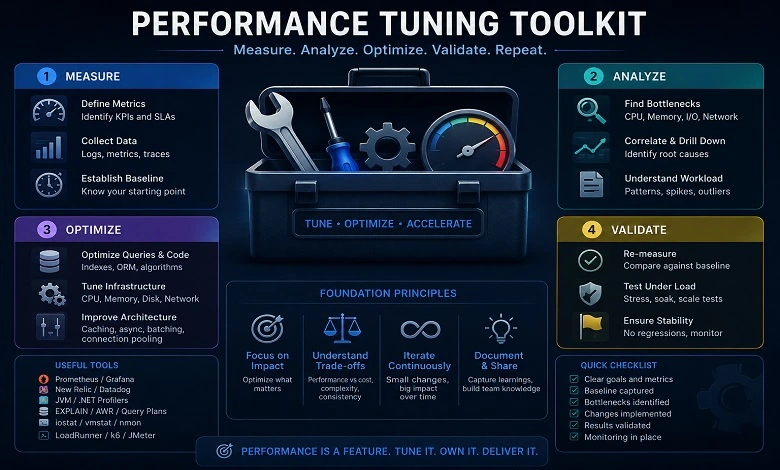
In an increasingly digital world, performance is everything. Whether it is a website loading in milliseconds, a cloud server handling millions of requests, a gaming PC delivering ultra-smooth gameplay, or a high-performance vehicle producing maximum horsepower, optimization has become a necessity rather than an option. Businesses, developers, IT administrators, automotive engineers, and even casual users rely on performance tuning strategies to improve speed, reliability, scalability, and efficiency.
At the center of this optimization process lies the performance tuning toolkit.
A performance tuning toolkit is far more than a collection of utilities. It is a comprehensive framework of monitoring systems, profiling software, diagnostic tools, benchmarking utilities, automation platforms, and optimization techniques designed to identify bottlenecks and maximize overall performance.
Modern systems are more complex than ever before. Applications interact with databases, APIs, cloud servers, containers, and third-party services simultaneously. Vehicles depend heavily on electronic control systems and software-driven engine management. Networks carry massive amounts of data every second. Without proper tuning, these systems can become inefficient, unstable, slow, and expensive to maintain.
This detailed guide explores everything you need to know about performance tuning toolkits, including their importance, components, benefits, optimization methods, industry applications, challenges, and future trends.
Understanding the Concept of a Performance Tuning Toolkit
A performance tuning toolkit refers to a collection of specialized tools and methodologies used to analyze, monitor, optimize, and maintain system performance. The toolkit may include hardware diagnostics, software profilers, network analyzers, benchmarking platforms, resource monitoring dashboards, and automated optimization frameworks.
The primary objective of performance tuning is to eliminate inefficiencies and ensure that a system operates at its highest possible capacity without sacrificing stability or reliability.
Performance tuning can be applied in several industries and technical environments, including:
- Software development
- Database management
- Cloud computing
- Automotive engineering
- Gaming systems
- Enterprise infrastructure
- Network administration
- Web development
- Cybersecurity operations
- High-performance computing environments
Every system contains limitations known as bottlenecks. These bottlenecks restrict the flow of data, reduce speed, increase resource consumption, and negatively impact user experience. A performance tuning toolkit helps locate those bottlenecks and provides actionable insights for resolving them.
For example, a web application may suffer from slow response times because of inefficient database queries. A gaming PC may overheat due to excessive GPU utilization. A vehicle engine may underperform because of poorly calibrated fuel injection timing. In all these cases, tuning tools help identify the root cause and improve overall efficiency.
Why Performance Tuning Has Become Essential
The demand for faster, more responsive systems continues to grow every year. Users expect websites to load instantly, applications to respond without lag, and digital services to remain available around the clock.
Even a small decrease in performance can lead to significant consequences.
For businesses, poor system performance often results in:
- Reduced customer satisfaction
- Lower conversion rates
- Increased bounce rates
- Higher operational costs
- Lost revenue opportunities
- Reduced employee productivity
- Downtime and service interruptions
In software engineering, performance optimization directly affects scalability. Applications that perform well under light traffic may fail under heavy workloads if they are not properly tuned.
Similarly, in the automotive world, performance tuning impacts fuel efficiency, acceleration, engine responsiveness, and overall driving experience.
Performance tuning is no longer limited to large enterprises or advanced engineers. Today, organizations of every size rely on optimization strategies to remain competitive.
Core Components of a Performance Tuning Toolkit
An effective performance tuning toolkit combines several categories of tools and technologies. Each component serves a specific purpose within the optimization process.
Monitoring and Observability Tools
Monitoring is the foundation of performance tuning. Without accurate visibility into system behaviour, optimization becomes guesswork.
Monitoring tools collect real-time performance metrics related to:
- CPU utilization
- Memory consumption
- Disk input and output
- Network traffic
- Thread activity
- Application response time
- Database queries
- API latency
- Temperature readings
- Resource allocation
Modern observability platforms provide centralized dashboards where administrators can visualize trends, detect anomalies, and identify performance degradation before it impacts users.
These tools continuously track infrastructure health and generate alerts when predefined thresholds are exceeded.
Popular monitoring platforms include:
- Grafana
- Prometheus
- Datadog
- Zabbix
- Nagios
- New Relic
- Dynatrace
Advanced monitoring systems also integrate artificial intelligence to predict failures and recommend optimization strategies automatically.
Profiling and Diagnostic Tools
Profiling tools analyze how applications behave during execution. They help developers understand exactly where resources are being consumed.
A profiler can reveal:
- Slow-running functions
- Excessive memory allocation
- CPU-intensive operations
- Thread contention
- Memory leaks
- Redundant computations
- Inefficient loops
- Excessive database calls
For developers, profiling is one of the most valuable optimization techniques because it provides precise insight into software inefficiencies.
Instead of blindly rewriting code, engineers can focus directly on the sections causing performance problems.
Common profiling tools include:
- VisualVM
- JProfiler
- YourKit
- Valgrind
- Perf
- Intel VTune
Profiling is especially important in high-scale applications where even minor inefficiencies can become costly under heavy traffic.
Benchmarking Utilities
Benchmarking tools measure system performance under controlled conditions.
These tools simulate workloads and evaluate how efficiently a system responds.
Benchmarking helps organizations:
- Compare hardware configurations
- Evaluate software optimizations
- Measure scalability
- Analyze throughput
- Detect performance regressions
- Validate infrastructure upgrades
For example, a database benchmark might simulate thousands of simultaneous transactions to determine how well the server handles high traffic.
Popular benchmarking utilities include:
- Apache JMeter
- Sysbench
- Geekbench
- Cinebench
- PCMark
- PassMark
Benchmarking creates measurable baselines that allow engineers to quantify improvements accurately.
Database Optimization Tools
Databases are among the most common sources of performance bottlenecks.
A poorly optimized database can slow down an entire application regardless of how efficient the rest of the system may be.
Database tuning tools focus on:
- Query optimization
- Index management
- Connection pooling
- Cache configuration
- Transaction optimization
- Replication performance
- Data partitioning
Database administrators use these tools to identify slow queries, analyze execution plans, and optimize storage performance.
Examples of database tuning platforms include:
- MySQL Workbench
- Oracle Enterprise Manager
- SQL Server Profiler
- pgAdmin
- Percona Toolkit
Proper database tuning can dramatically improve application speed, especially for data-intensive systems.
Network Performance Analysis Tools
Network bottlenecks often create hidden performance issues that are difficult to diagnose without specialized tools.
- Packet loss
- Connection delays
- DNS latency
- Firewall performance
- Bandwidth utilization
- Routing inefficiencies
- Network congestion
These tools are essential in distributed environments where applications depend on constant communication between multiple servers and services.
Widely used network analysis tools include:
- Wireshark
- SolarWinds
- PRTG Network Monitor
- Nmap
- NetFlow Analyzer
Efficient networking is critical for maintaining low latency and high availability.
Performance Tuning in Software Development
Software optimization remains one of the most important applications of performance tuning.
Modern applications are expected to process large amounts of data while maintaining exceptional responsiveness.
Even small delays can negatively affect user engagement and customer satisfaction.
Code Optimization
The first stage of software tuning usually involves improving code efficiency.
Developers optimize:
- Algorithms
- Data structures
- Memory allocation
- Thread synchronization
- API requests
- Background processing
- Resource management
Inefficient algorithms often create unnecessary CPU load and memory consumption.
For example, replacing a quadratic-time algorithm with a logarithmic or linear alternative can dramatically improve performance at scale.
Code optimization also involves removing redundant operations and minimizing expensive calculations.
Frontend Performance Optimization
Frontend optimization focuses on improving website responsiveness and user experience.
Search engines prioritize fast-loading websites because performance directly impacts usability.
Frontend tuning strategies include:
- Image compression
- Browser caching
- JavaScript minification
- CSS optimization
- Lazy loading
- Content delivery networks
- Reducing HTTP requests
Fast websites not only improve SEO rankings but also increase conversion rates and reduce bounce rates.
Backend Optimization
Backend performance tuning focuses on server-side efficiency.
- Database query optimization
- API caching
- Load balancing
- Compression
- Asynchronous processing
- Queue management
- Resource allocation
A backend tuning ensures that applications remain stable under heavy workloads.
Cloud-native applications particularly benefit from backend optimization because they often operate within distributed environments.
Cloud Infrastructure Performance Tuning
Cloud computing has transformed how organizations deploy and manage applications.
However, cloud environments introduce additional performance challenges because workloads constantly fluctuate.
Cloud performance tuning focuses on maximizing efficiency while minimizing operational costs.
Resource Allocation Optimization
Cloud administrators optimize:
- CPU allocation
- Memory provisioning
- Storage configuration
- Virtual machine sizing
- Container orchestration
Improper resource allocation leads to wasted infrastructure spending and reduced application performance.
Container and Kubernetes Optimization
Containerized applications require specialized tuning strategies.
Administrators optimize:
- Pod scheduling
- Resource limits
- Auto-scaling policies
- Cluster balancing
- Container startup performance
Kubernetes optimization has become a major focus area in modern DevOps environments.
Serverless Performance Tuning
Serverless architectures also require optimization.
Common serverless tuning strategies include:
- Reducing cold start times
- Optimizing function execution
- Managing concurrency limits
- Improving API gateway efficiency
Organizations increasingly rely on automated cloud tuning systems powered by machine learning algorithms.
Automotive Performance Tuning Toolkit
The automotive industry has embraced advanced tuning technologies to improve vehicle performance.
Modern vehicles rely heavily on electronic control units (ECUs), sensors, and software-driven engine management systems.
Automotive performance tuning toolkits help optimize:
- Horsepower
- Torque
- Fuel efficiency
- Turbo boost pressure
- Ignition timing
- Air-fuel ratios
- Transmission behavior
- Throttle response
Enthusiasts and professional tuners use ECU remapping tools to adjust engine parameters safely.
Popular automotive tuning platforms include:
- HP Tuners
- EFI Live
- Cobb Accessport
- Hondata
- KESSv2
When performed correctly, automotive tuning can significantly improve acceleration, responsiveness, and driving experience.
However, improper tuning may reduce reliability or damage engine components.
For this reason, professional diagnostics and careful calibration are essential.
Gaming System Performance Tuning
Gamers constantly seek ways to maximize frame rates, reduce latency, and improve hardware efficiency.
Gaming performance tuning often focuses on:
- GPU optimization
- CPU overclocking
- Memory timing adjustments
- Thermal management
- Storage optimization
- Driver updates
- Background process management
Gaming optimization tools help users monitor temperatures, clock speeds, and resource utilization in real time.
Popular gaming performance utilities include:
- MSI Afterburner
- RivaTuner
- HWMonitor
- CPU-Z
- GPU-Z
Thermal tuning is particularly important because overheating can lead to throttling and reduced gaming performance.
The Role of Artificial Intelligence in Performance Tuning
Artificial intelligence is transforming the future of optimization.
Traditional tuning methods often require extensive manual analysis and experimentation.
AI-driven tuning systems can automate much of this process.
Machine learning algorithms analyze historical performance data and automatically recommend configuration changes.
AI-based tuning platforms can:
- Predict bottlenecks
- Detect anomalies
- Optimize workloads dynamically
- Adjust resource allocation automatically
- Prevent system failures
- Improve scalability
These intelligent systems continuously learn from operational patterns and adapt in real time.
As infrastructure complexity grows, AI-driven tuning is becoming increasingly important.
Best Practices for Effective Performance Tuning
Successful optimization requires a systematic approach.
Organizations that apply random changes without proper measurement often create additional problems.
The following best practices help ensure effective tuning.
Begin with Accurate Measurement
Performance tuning should always start with data collection.
Administrators must establish baseline metrics before making any changes.
Without baselines, it becomes impossible to measure improvement accurately.
Monitoring tools should capture:
- Average response times
- CPU usage
- Memory utilization
- Network throughput
- Error rates
- Disk performance
Reliable measurement prevents unnecessary optimization efforts.
Identify the Real Bottleneck
Many systems contain multiple inefficiencies, but only a few significantly impact overall performance.
Optimizing the wrong component wastes time and resources.
For example, increasing CPU power will not improve performance if the primary bottleneck is slow database queries.
Accurate profiling and monitoring help identify the true source of performance degradation.
Optimize Incrementally
Large-scale configuration changes can create instability.
Experienced engineers make small, controlled adjustments and evaluate the results carefully.
Incremental optimization reduces risk and simplifies troubleshooting.
Prioritize Stability
Maximum speed should never come at the cost of reliability.
Aggressive tuning can cause crashes, overheating, memory corruption, or hardware damage.
A balanced approach ensures long-term system stability.
Continuously Monitor Performance
Performance tuning is not a one-time activity.
Applications evolve, workloads increase, and infrastructure changes over time.
Continuous monitoring helps organizations detect new bottlenecks before they become critical issues.
Common Challenges in Performance Tuning
Despite its benefits, performance optimization is often complex.
Modern systems contain thousands of configurable parameters, making tuning highly challenging.
High System Complexity
Distributed architectures involve multiple interacting services.
A single performance issue may involve:
- Databases
- APIs
- Network latency
- Load balancers
- Containers
- Third-party integrations
Diagnosing problems across distributed systems requires advanced observability tools.
Resource Constraints
Optimization cannot fully compensate for inadequate hardware.
Systems with outdated CPUs, insufficient memory, or slow storage devices may require infrastructure upgrades.
Over-Optimization Risks
Excessive tuning can create maintenance challenges.
Highly optimized configurations may become difficult to understand or manage.
Complex tuning strategies should always be documented carefully.
Dynamic Workloads
Modern applications experience constantly changing workloads.
Traffic spikes, seasonal demand, and user growth require adaptive optimization strategies.
Static configurations may become inefficient over time.
Open-Source vs Commercial Performance Tuning Toolkits
Organizations often choose between open-source and commercial tuning solutions.
Each option offers unique advantages.
Open-Source Toolkits
Open-source solutions provide flexibility and cost savings.
Advantages include:
- No licensing fees
- Community-driven innovation
- Extensive customization
- Large developer communities
Popular open-source tools include:
- Grafana
- Prometheus
- Zabbix
- Wireshark
- Apache JMeter
However, open-source tools may require greater technical expertise.
Commercial Toolkits
Commercial platforms often provide enterprise-grade features and dedicated support.
Advantages include:
- Advanced analytics
- AI-powered insights
- Integrated dashboards
- Professional support
- Simplified deployment
Popular commercial solutions include:
- Datadog
- Dynatrace
- AppDynamics
- New Relic
Commercial tools are frequently preferred by large enterprises managing complex infrastructures.
Future Trends in Performance Tuning
Performance tuning technologies continue to evolve rapidly.
Several emerging trends are shaping the future of optimization.
Autonomous Optimization
AI-powered systems are becoming capable of automatically adjusting configurations without human intervention.
These systems continuously optimize workloads in real time.
Predictive Analytics
Predictive performance platforms use historical data to forecast future bottlenecks.
Organizations can proactively resolve issues before they impact users.
Edge Computing Optimization
As edge computing expands, performance tuning will increasingly focus on low-latency distributed environments.
Green Computing and Energy Efficiency
Modern optimization strategies increasingly prioritize energy efficiency.
Reducing power consumption lowers operational costs and supports sustainability goals.
Conclusion
A performance tuning toolkit is an essential resource for optimizing modern systems, applications, networks, cloud infrastructure, and automotive platforms.
In today’s highly competitive digital environment, performance directly influences customer satisfaction, operational efficiency, scalability, and profitability.
Effective tuning involves more than simply increasing speed. It requires careful analysis, continuous monitoring, strategic optimization, and long-term maintenance.
The most successful organizations follow a structured optimization process:
- Measure system behaviour accurately
- Identify bottlenecks
- Apply targeted improvements
- Test performance changes
- Monitor results continuously
From software development and cloud computing to gaming systems and automotive engineering, performance tuning toolkits help users maximize efficiency while maintaining reliability.
As artificial intelligence, machine learning, and automation technologies continue to advance, performance tuning will become even more intelligent, adaptive, and autonomous.
Organizations that invest in proper optimization strategies today will be better prepared to handle the increasing demands of tomorrow’s digital world.