
 By Mikel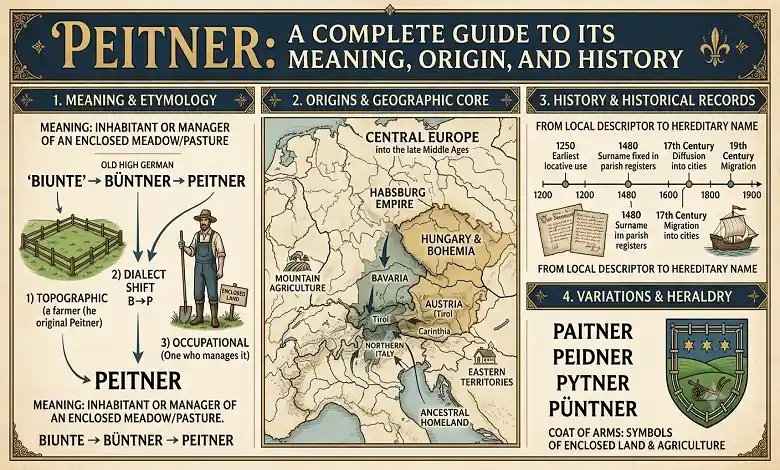
Names often carry fascinating stories, connecting families to their heritage, geography, and cultural traditions. While some surnames are widely recognized, others remain relatively uncommon yet hold a rich historical background. Peitner is one such name. Although not as common as many European surnames, it has gained attention among genealogy researchers, historians, and individuals exploring their family roots.
Whether you’re researching your ancestry, curious about the meaning of the surname, or simply interested in European family history, understanding the story behind Peitner offers valuable insights into how surnames evolved over centuries.
In this guide, we’ll explore the meaning of Peitner, its historical origins, regional connections, surname variations, notable individuals, and practical tips for tracing the family name.
What Does Peitner Mean?
The exact meaning of Peitner is not universally agreed upon, but historians and genealogy researchers generally associate it with Central European naming traditions.
Like many Germanic surnames, Peitner likely originated as a descriptive or geographical family name. In earlier centuries, people were often identified by where they lived, the work they performed, or a distinguishing characteristic. Over time, these descriptions became hereditary surnames passed down through generations.
Some researchers suggest that Peitner may have evolved from regional dialects or older German-language forms used in Alpine communities. Others believe it shares linguistic roots with related surnames that developed across Austria and southern Germany. Because historical records vary by region and spelling, the exact origin remains a subject of ongoing genealogical research rather than a confirmed fact.
The Historical Origin of the Peitner Surname
The surname Peitner has long been associated with parts of Central Europe, particularly areas where German-speaking communities flourished.
Regions commonly linked to the surname include:
- Austria
- Southern Germany
- South Tyrol (Northern Italy)
- Parts of Switzerland
During the Middle Ages, surnames became increasingly important as populations grew and governments required more accurate records for taxation, land ownership, and legal matters. Many families adopted surnames based on their village, nearby landscape, occupation, or family lineage.
Historical migration also played an important role. As families moved across Europe for work, trade, or political reasons, local officials often recorded surnames according to regional pronunciation, creating multiple spelling variations over time.
How the Name Changed Over Time
One interesting aspect of European surnames is that spelling was rarely standardized before the nineteenth century.
As a result, a single family might appear in historical records with different spellings depending on the language, dialect, or even the clerk who recorded the information.
Common variations associated with Peitner include:
- Peintner
- Peidner
- Peitnor
- Pitner (in some migration records)
- Leitner (occasionally confused due to pronunciation)
Among these, Peintner is one of the most frequently documented variants in historical records from Alpine regions. Researchers tracing family history should consider alternative spellings when searching archives, church registers, or immigration documents.
Where Is the Peitner Name Found Today?
Although relatively uncommon, the Peitner surname continues to appear in several countries.
Modern records and genealogy databases show families with this surname in:
- Austria
- Germany
- Italy (especially South Tyrol)
- United States
- Canada
- Australia
Many descendants of European immigrants carried the surname overseas during the nineteenth and twentieth centuries, establishing new family branches while preserving their ancestral heritage.
Because the name is uncommon, individuals researching the Peitner family often discover valuable historical connections through immigration records, census data, and church archives.
Famous People Associated with the Name
Although the surname is relatively rare, several individuals connected with the Peitner or closely related Peintner family name have gained recognition in creative and professional fields.
These include artists, architects, educators, athletes, and researchers whose work has contributed to their respective industries.
One notable example is Max Peintner, whose imaginative artwork has earned international recognition for its thought-provoking themes.
The success of individuals carrying related forms of the surname demonstrates how family names continue to evolve while remaining connected to their historical roots.
Why People Research the Peitner Surname
Interest in genealogy has grown significantly over the past decade.
People researching the Peitner surname often have several goals:
- Discovering family origins
- Building a family tree
- Identifying immigrant ancestors
- Learning about regional history
- Connecting with distant relatives
- Preserving family heritage
Online genealogy databases, digitized archives, and DNA testing services have made it easier than ever to explore family history.
However, because Peitner is a relatively uncommon surname, researchers often need to examine multiple historical sources to verify family connections.
Tips for Researching the Peitner Family History
If you’re exploring the Peitner surname, consider following these best practices.
Start With Family Records: Gather birth certificates, marriage records, family photographs, and letters before searching public databases.
Interview Older Relatives: Grandparents and elderly family members often remember valuable information that may not appear in official documents.
Search Alternative Spellings: Historical documents may record the surname differently depending on language or local pronunciation.
Explore Church Registers: Before civil registration became common, churches recorded baptisms, marriages, and burials.
Review Immigration Records: Passenger lists, naturalization documents, and census records often provide important clues about family migration.
Consider DNA Testing: Modern ancestry DNA services can help identify relatives and geographic origins that complement traditional documentary research.
Cultural Importance of Family Names
Surnames represent more than simple identifiers.
They connect generations, preserve cultural traditions, and reflect the movement of people across countries and centuries.
For families carrying the Peitner surname, understanding its background provides a deeper appreciation of their ancestral journey and historical identity.
Even when exact historical details remain uncertain, studying surname origins helps preserve family stories for future generations.
Interesting Facts About Peitner
Here are a few interesting facts about the surname:
- Peitner is considered a relatively rare European surname.
- It is most commonly associated with German-speaking regions.
- Several spelling variations exist due to historical record-keeping.
- Many modern families with the surname trace their ancestry to Central Europe.
- Interest in the surname has increased alongside the growing popularity of genealogy and family history research.
Conclusion
Although Peitner is not among the most common European surnames, it represents a fascinating part of Central European history. Its connections to German-speaking regions, multiple spelling variations, and enduring presence in modern genealogy make it an interesting subject for anyone researching family heritage.
While some aspects of the surname’s exact origin remain open to interpretation, available historical and genealogical evidence suggests a long-standing association with Alpine communities and Germanic naming traditions. By exploring family documents, historical records, and reputable genealogy resources, individuals carrying the Peitner name can uncover valuable insights into their ancestry and preserve that history for future generations.
Whether your interest is personal, historical, or academic, the story of Peitner serves as a reminder that every surname carries a unique journey through time—one shaped by migration, culture, language, and the lives of the families who passed it on.
Frequently Asked Questions
A. No. Peitner is considered relatively uncommon compared to many European surnames, making genealogical research both challenging and rewarding.
A. Most historical evidence links the surname to German-speaking regions of Central Europe, particularly Austria, southern Germany, and South Tyrol, though the precise origin remains uncertain.
A. Many genealogy researchers consider Peintner to be a closely related spelling variation that may share the same linguistic roots, although individual family histories can differ.
A. Start with family records, search historical archives using multiple surname spellings, consult church and civil records, and consider DNA testing to complement documentary evidence.
A. Before standardized spelling, surnames were often written phonetically by local officials, leading to multiple recorded variations across regions and generations.