
 By Mikel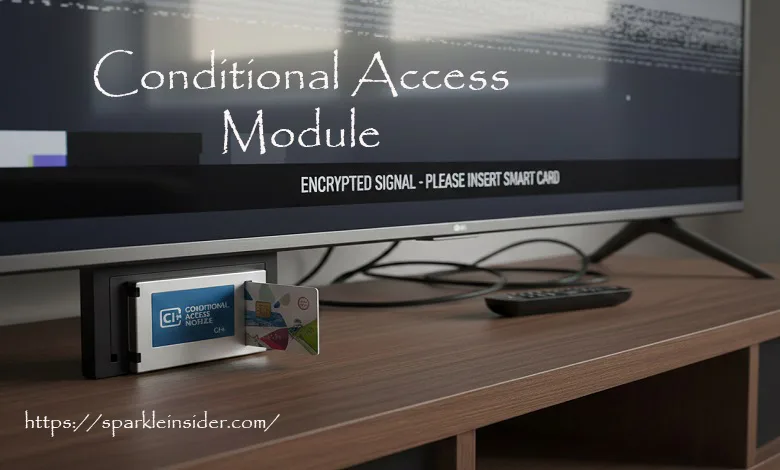
Digital television changed how audiences consume content. From satellite broadcasting to cable networks and terrestrial transmission, modern TV ecosystems rely on encryption to control who can watch premium content. At the centre of this security architecture sits a small but powerful device: the conditional access module (CAM).
Although physically compact, the CAM performs a crucial role in enforcing subscriptions, preventing piracy, and enabling broadcasters to monetize their programming. Without conditional access technology, pay-TV services would struggle to protect their revenue streams and control distribution rights.
This article provides a comprehensive, in-depth explanation of the CAM conditional access module, its technology, how it works, industry standards, and how manufacturers such as Sony integrate conditional access module systems into their televisions.
What Is a Conditional Access Module?
A conditional access module is an electronic device inserted into a digital television or set-top box to enable viewing of encrypted broadcast content. It works alongside a conditional access system (CAS) that determines whether a viewer is authorized to access specific channels or services.
Typically, the CAM contains:
- A processor and security firmware
- A smart-card slot or embedded secure element
- Interfaces for communication with the host device
- Software that interprets entitlement messages
The module acts as a gatekeeper, ensuring that only authorized users can decrypt and watch protected television signals.
Without the CAM, a TV might receive the signal, but cannot display the content because the data remains encrypted.
CAM Conditional Access Module: Why It Exists
The broadcast industry needs a way to deliver premium content while protecting intellectual property. Conditional access technology solves this problem by encrypting programs and distributing keys only to subscribers.
The CAM is responsible for handling the subscriber authentication process and securely providing decryption information to the TV or receiver.
From a business perspective, CAMs enable:
- Subscription-based pay-TV models
- Pay-per-view services
- Regional content licensing control
- Digital rights management enforcement
For viewers, the CAM provides convenience. Instead of using a bulky set-top box, many modern TVs allow users to insert a module directly into a slot and access paid channels seamlessly.
How a Conditional Access Module Works
To understand the CAM, imagine a digital broadcast as a locked stream of information. The TV can receive it, but only the CAM knows how to unlock it.
Step-by-Step Operation
- Signal Reception
The TV tuner receives a digital broadcast stream that includes video, audio, and encryption messages. - Message Routing
Special messages called ECMs and EMMs are sent to the CAM. These contain encrypted control information and subscription data. - Authentication
The CAM checks the subscriber credentials stored in the smart card or internal secure chip. - Key Extraction
If the subscription is valid, the CAM extracts short-term decryption keys called control words. - Decryption Process
The TV’s decoder uses those keys to descramble the video stream. - Playback
The viewer sees the program normally.
This process happens in seconds, often rotating keys every few seconds to maintain security.
Common Interface (CI) and CI+ Technology
Most CAM conditional access modules connect to TVs using the Common Interface (CI) standard, which was developed for Digital Video Broadcasting (DVB).
The Common Interface provides a universal slot allowing different CAMs to work with different encryption systems.
Later, the industry introduced CI+, an enhanced version offering:
- Secure authentication between the module and the TV
- Encrypted communication links
- Copy-protection controls
- Stronger anti-piracy measures
CI+ became especially important as broadcasters began offering HD and 4K content that required stricter protection.
Types of CAM Conditional Access Modules
Not all CAMs are identical. Different broadcasting environments require different implementations.
1. Standard Consumer CAM
Designed for home TVs, these modules handle a single subscription card and decrypt selected channels.
2. Professional CAM
Used in hotels, hospitals, or broadcasting racks, professional CAMs can decrypt multiple channels simultaneously.
3. Card-Based CAM
These include a slot for a removable smart card issued by the provider.
4. Cardless CAM
Newer modules integrate the secure element internally, eliminating the need for a separate card.
5. Multi-Crypt CAM
Some advanced modules can support multiple encryption systems simultaneously, allowing compatibility with various providers.
Conditional Access Systems Supported by CAMs
CAMs must be compatible with the encryption systems used by broadcasters. Popular CAS technologies include:
- Nagravision
- Viaccess
- Irdeto
- Conax
- Mediaguard
- Verimatrix
Each CAS uses different key management and encryption methods, but the CAM acts as the interface, translating them for the TV.
Conditional Access Module Sony: Integration in Smart TVs
Major television manufacturers incorporate CI+ support into their devices. Sony is one of the brands that widely supports CAM modules.
How Sony TVs Use CAM Technology
Sony televisions equipped with CI or CI+ slots allow users to insert a compatible conditional access module directly into the TV.
This provides several advantages:
1. No Set-Top Box Required
Users can watch subscription channels without external hardware.
2. Simplified Setup
The CAM integrates directly with Sony’s TV software and channel scanning system.
3. Improved Viewing Experience
Without additional cables or devices, picture quality and response times may improve.
4. Operator-Approved Modules
Sony TVs support modules certified by cable or satellite operators, ensuring compatibility with regional CAS systems.
In many regions, cable companies provide a CAM module instead of a set-top box specifically for CI-enabled televisions like Sony models.
Benefits of Using a CAM Conditional Access Module
1. Reduced Hardware Clutter
One of the biggest advantages of CAM technology is eliminating external receivers.
2. Flexibility
Users can switch providers by replacing the module rather than the entire television.
3. Improved Security
Because CAMs operate within tamper-resistant hardware, they provide strong anti-piracy protection.
4. Standardization
The CI/CI+ system ensures interoperability between TVs and CAM vendors.
5. Energy Efficiency
Fewer devices mean lower power consumption.
Challenges and Limitations of CAM Technology
Despite their usefulness, CAM conditional access modules face several limitations.
Compatibility Issues
Not all CAMs work with all TVs. Differences in firmware, CAS versions, and regional standards can create problems.
Security Arms Race
Broadcasters continuously update encryption systems to prevent piracy. This sometimes requires replacing older modules.
Limited Interactive Features
Compared to operator set-top boxes, CAM-based viewing may lack advanced features like cloud recording or on-demand services.
Regional Availability
Some countries rely heavily on CAMs, while others prefer proprietary boxes.
CAM vs Set-Top Box: Which Is Better?
Both technologies deliver encrypted TV, but they differ significantly.
| Feature | CAM | Set-Top Box |
| Hardware footprint | Small module | Separate device |
| Ease of setup | Simple | Moderate |
| Interactive features | Limited | Extensive |
| Energy use | Low | Higher |
| Provider control | Less | More |
For basic viewing, CAM modules are convenient. For advanced features, providers often still use dedicated receivers.
Future of Conditional Access Modules
The television industry is shifting toward IP-based broadcasting and streaming platforms. However, CAMs are unlikely to disappear soon.
Future developments may include:
- Integration with hybrid broadcast-broadband TV systems
- Support for IP-based encryption models
- Software-defined CAM functionality
- USB or embedded CI modules replacing PC-card formats
Even as streaming grows, many countries continue using broadcast pay-TV systems where CAMs remain essential.
Security Importance of CAM Conditional Access Modules
The main purpose of CAMs is to protect revenue. By restricting access to authorized viewers, they ensure broadcasters receive payment for their content.
From a security standpoint, CAMs must:
- Protect encryption keys
- Prevent cloning or emulation
- Authenticate hosts and subscribers
- Rotate keys frequently
If the hardware security of a CAM is compromised, pirates may emulate it and decrypt channels illegally.
Therefore, manufacturers constantly update hardware and firmware to maintain trust in the system.
Real-World Applications of CAM Technology
CAMs are widely used across various broadcast environments:
- Satellite television subscriptions
- Digital cable networks
- Terrestrial pay-TV
- Hospitality television distribution
- Institutional broadcasting setups
Their modular nature makes them adaptable to different systems and regions.
Also Read: Pasonet: The Future of Digital Connectivity, Payments, and Smart Networks
Conclusion
The conditional access module may appear to be a small accessory, but it plays a foundational role in digital broadcasting security.
By verifying subscriptions, managing decryption keys, and interfacing with television hardware, CAM modules enable broadcasters to deliver premium content safely and efficiently.
Whether integrated into modern Sony televisions or used in professional broadcasting racks, CAM technology remains a crucial component of the pay-TV ecosystem.
As broadcasting evolves toward hybrid and IP-based systems, conditional access modules will likely adapt rather than disappear, continuing to serve as the security backbone of encrypted media distribution.