
 By Mikel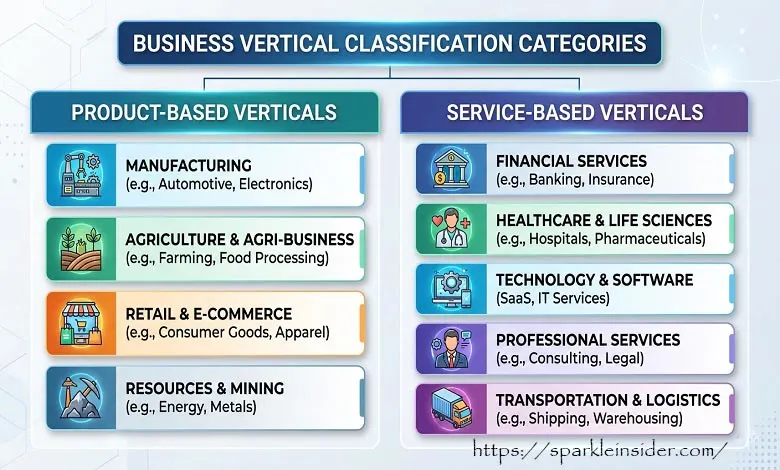
Introduction to Business Vertical Classification Categories
In today’s complex business environment, companies are no longer understood simply by what they sell. Instead, they are analyzed based on where they operate, who they serve, and how they create value. This is where the concept of business vertical classification categories becomes essential.
Business vertical classification categories are used to organize companies into structured groups based on their industry, products, services, and target customers. These categories are not just labels—they act as a framework that helps businesses, analysts, and investors understand how different industries function and interact.
Without this kind of classification, comparing companies, identifying opportunities, or even understanding competition would become extremely difficult. In modern markets, where businesses often operate globally and across multiple sectors, classification brings clarity and structure.
What is a Business Vertical in Real Terms
A business vertical is best understood as a focused segment of a broader market. It represents a group of businesses that serve a specific industry or customer type with tailored solutions.
For example, consider a software company. If it builds general accounting software used by many industries, it operates horizontally. But if it develops software only for hospitals, then it belongs to the healthcare vertical.
This difference matters because vertical businesses:
- Focus on specific customer needs
- Adapt to industry regulations and workflows
- Build specialized expertise over time
Vertical markets are therefore narrower but deeper. They require a strong understanding of the industry they serve, which often leads to better solutions and stronger customer relationships.
Meaning of Business Vertical Classification Categories
When we talk about business vertical classification categories, we are referring to a structured system that groups companies based on shared characteristics such as:
- Industry type
- Product or service offerings
- Customer segment
- Operational model
These categories help create a clear map of the business ecosystem, allowing companies to identify where they belong and how they compare with others.
For instance, healthcare, finance, retail, and technology are not just industries—they are classification categories that define how businesses operate within them.
Why Business Vertical Classification is Important
Business vertical classification is not just an academic concept—it has real-world applications across multiple areas.
One of the most important uses is market understanding. When businesses are grouped into verticals, it becomes easier to analyze trends, demand patterns, and growth opportunities within each segment.
It also plays a key role in strategy development. Companies can tailor their products, pricing, and marketing strategies based on the specific characteristics of their vertical.
Another major benefit is risk and compliance management. Certain industries, such as healthcare and finance, have strict regulations. Proper classification helps businesses identify these requirements early and ensure compliance.
From an investment perspective, classification allows analysts to compare companies within the same category, making it easier to evaluate performance and potential.
Core Principles Behind Vertical Classification
Business vertical classification is built on a few fundamental principles that ensure consistency and accuracy.
The first principle is similarity of economic activity. Companies that produce similar goods or services are groupe. This is the foundation of most classification systems use globally.
The second principle is customer focus. Businesses serving similar audiences often face the same challenges and opportunities, making them suitable for classification within the same vertical.
Another important principle is operational structure. Companies with similar processes, supply chains, and regulatory environments are often grouped because they operate in comparable ways.
Finally, market behavior is considered. Industries that respond similarly to economic changes, technological shifts, or consumer trends are often classified together.
Major Business Vertical Classification Categories Explained
Business vertical classification categories are often grouped into major industry segments. Each of these segments represents a distinct part of the economy.
Healthcare Vertical
The healthcare vertical includes businesses that provide medical services, products, and technologies. This is one of the most complex verticals because it combines multiple sub-sectors such as pharmaceuticals, hospitals, diagnostics, and health technology.
What makes healthcare unique is its strict regulatory environment and high dependency on research and innovation. Companies in this vertical must comply with safety standards, government regulations, and ethical guidelines.
Technology Vertical
The technology vertical is one of the most dynamic and rapidly evolving categories. It includes businesses involved in software development, hardware production, cybersecurity, artificial intelligence, and cloud computing.
Unlike traditional industries, technology often acts as an enabler for other verticals, meaning it overlaps with healthcare, finance, retail, and more.
Financial Services Vertical
The financial vertical includes banks, insurance companies, investment firms, and fintech platforms. This category is heavily influenced by economic conditions and government policies.
Companies in this vertical must manage risk, compliance, and trust, making it one of the most regulated sectors in the business world.
Retail and E-commerce Vertical
Retail focuses on selling goods directly to consumers, while e-commerce extends this into online platforms.
This vertical is driven by:
- Consumer behaviour
- Supply chain efficiency
- Pricing strategies
It is also one of the most competitive sectors, requiring businesses to constantly adapt to changing customer preferences.
Manufacturing Vertical
Manufacturing involves the production of goods from raw materials. This vertical includes industries such as automotive, electronics, and industrial equipment.
What sets manufacturing apart is its reliance on:
- Supply chains
- Production processes
- Global trade networks
Education Vertical
The education vertical includes schools, universities, and online learning platforms. With the rise of digital technology, this sector has expanded significantly.
It now includes:
- E-learning platforms
- Skill development programs
- Corporate training services
Energy and Utilities Vertical
This vertical includes businesses involved in energy production and distribution, such as oil, gas, and renewable energy companies.
Energy is a foundational sector because it supports all other industries. Changes in this vertical can have a widespread impact on the global economy.
Real Estate Vertical
The real estate vertical includes property development, sales, and management. It is closely linked to economic conditions, interest rates, and urban development.
Agriculture and Primary Industries
This category represents the primary sector, which focuses on extracting natural resources such as crops, minerals, and raw materials.
It forms the base of the economic structure, supporting manufacturing and other industries.
Services and Hospitality Vertical
This vertical includes businesses that provide services rather than physical products, such as tourism, transportation, and food services.
It is highly dependent on consumer demand and economic conditions.
Types of Business Classification Systems
Business vertical classification categories can be structured in different ways depending on the purpose.
One common approach is industry-based classification, where businesses are grouped by sector.
Another approach is product-based classification, which focuses on what companies produce.
There is also market-based classification, which groups businesses based on their target audience, such as B2B or B2C markets.
Geographic classification is another method, where businesses are grouped based on location.
Finally, sector-based classification divides the economy into broader categories such as primary, secondary, tertiary, and quaternary sectors.
Real-World Classification Systems
In practice, several formal classification systems are used globally.
One example is the Standard Industrial Classification (SIC) system, which assigns codes to businesses based on their activities. These codes follow a hierarchical structure, moving from general categories to more specific subcategories.
Another widely used system is the Global Industry Classification Standard (GICS), which divides companies into sectors, industries, and sub-industries.
These systems are used by governments, financial institutions, and researchers to analyze economic data and track industry performance.
Vertical vs Horizontal Markets
Understanding the difference between vertical and horizontal markets is crucial.
Vertical markets focus on a specific industry and provide specialized solutions. Horizontal markets, on the other hand, offer general solutions that can be used across multiple industries.
For example:
- A healthcare software provider operates in a vertical market
- A general office software provider operates in a horizontal market
Vertical markets allow businesses to develop deep expertise, while horizontal markets provide broader reach.
Challenges in Business Vertical Classification
While classification is useful, it is not always simple.
Many modern companies operate across multiple verticals. For example, a technology company may also be involved in retail, logistics, and cloud services.
This creates challenges in determining the primary classification of a business.
Another challenge is the rapid evolution of industries. New sectors such as fintech, edtech, and health-tech blur traditional boundaries, making classification more complex.
Future of Business Vertical Classification Categories
As markets evolve, classification systems are becoming more advanced.
Data-driven approaches are now being used to analyze companies based on real-time information, allowing for more accurate and dynamic classification.
Artificial intelligence is also being applied to identify patterns and relationships between industries, improving the precision of classification systems.
At the same time, new verticals are emerging as technology continues to reshape industries. This ensures that classification systems remain relevant and adaptable.
Conclusion
Business vertical classification categories provide a structured way to understand how companies operate within the global economy. By grouping businesses based on industry, products, and customer focus, these categories make it easier to analyze markets, develop strategies, and make informed decisions.
From healthcare and technology to finance and manufacturing, each vertical represents a unique segment with its own characteristics and challenges. Understanding these classifications is essential for anyone looking to navigate the modern business landscape effectively.
As industries continue to evolve, the importance of accurate and flexible classification systems will only grow, making them a key tool for businesses, analysts, and investors alike.
FAQs on Business Vertical Classification Categories
A. Business vertical classification categories are structure groups that organize businesses base on their industry, products, services, and target customers. They help simplify how different sectors are understand and compare.
A. Business vertical classification categories are important because they help companies, analysts, and investors understand market structure, identify competitors, and make informed strategic decisions.
A. In business vertical classification categories, a vertical market focuses on one specific industry, while a horizontal market serves multiple industries with general solutions.
A. Yes, many companies operate across multiple business vertical classification categories, especially large organizations that offer a range of products or services in different industries.
A. Common examples of business vertical classification categories include healthcare, technology, finance, retail, manufacturing, education, and energy.