
 By Mikel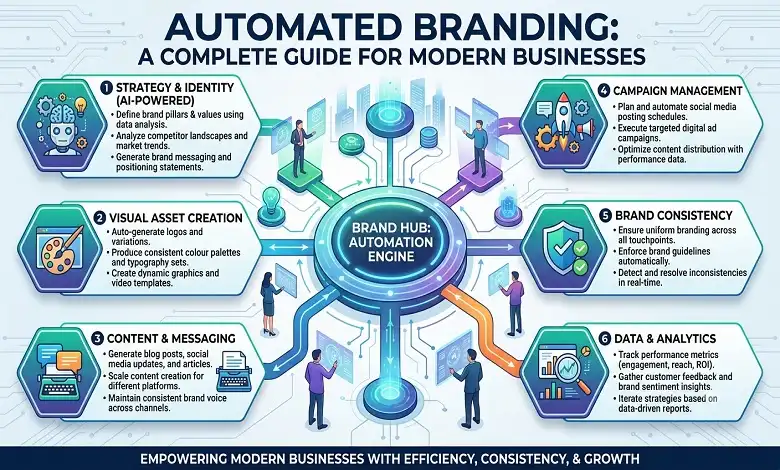
Building a strong brand requires more than an attractive logo or memorable slogan. Modern businesses need to maintain a consistent identity across websites, social media, email campaigns, advertisements, and other customer touchpoints. This is where automated branding can make a significant difference.
Automated branding uses software, artificial intelligence, templates, and predefined workflows to handle repetitive branding and marketing activities. It helps businesses save time while keeping their messaging, visuals, and customer experience consistent.
What Is Automated Branding?
Automated branding is the use of digital tools and automated processes to manage different parts of a brand’s identity and marketing activities. Instead of completing every branding task manually, businesses can automate repetitive work while keeping important creative and strategic decisions under human control.
For example, a company can create brand templates for social media posts, automate email communications, schedule branded content, and use AI-powered tools to generate ideas that follow specific brand guidelines.
The goal is not to remove the human side of branding. Instead, automation allows teams to spend more time on strategy, creativity, customer relationships, and business growth.
Why Is Automated Branding Important?
Brand consistency can become difficult as a business grows. Different employees may use different colours, fonts, writing styles, images, or messages. These small differences can make a brand appear less organised.
Automated branding helps establish repeatable processes. Once brand guidelines and workflows are set up, many routine tasks can follow the same standards.
Some important advantages include:
- Better brand consistency
- Faster content production
- Reduced repetitive work
- More efficient marketing workflows
- Easier management of multiple channels
- Improved team productivity
- Scalable branding processes
For small businesses and startups, automation can be especially useful because teams often have limited time and resources.
Key Elements of Automated Branding
Automated branding can involve several areas of business communication and marketing.
1. Brand Templates
Templates help businesses maintain a consistent appearance across different types of content. Social media graphics, presentations, advertisements, newsletters, and documents can all follow predefined layouts.
Templates may include approved fonts, colours, logos, image styles, and other visual elements.
2. Automated Content Creation
AI and marketing platforms can help generate content ideas, social media captions, email drafts, product descriptions, and other marketing materials.
Businesses can provide brand guidelines, preferred language, audience information, and communication goals to create content that better matches their identity.
Human review remains important, particularly for customer-facing content.
3. Social Media Automation
Social media management platforms can schedule branded posts across multiple channels. Businesses can prepare content in advance and publish it according to a planned schedule.
This makes it easier to maintain an active presence without manually posting every day.
4. Email Marketing Automation
Email automation can support branded communication throughout the customer journey. Welcome emails, newsletters, product updates, reminders, and follow-up messages can be created as automated campaigns.
Using consistent templates and messaging helps customers recognise the business across different communications.
5. Brand Asset Management
Companies often have many brand assets, including logos, photographs, graphics, videos, documents, and marketing templates.
Digital asset management systems can organise these resources and make approved materials easier for teams to find and use.
Benefits of Automated Branding for Modern Businesses
Saves Time
Manual branding tasks can consume many hours every week. Automation handles repetitive activities, allowing employees to concentrate on higher-value responsibilities.
Improves Consistency
A consistent brand is easier for customers to recognise. Automated templates and workflows can reduce variations in visual design and messaging.
Supports Business Growth
As a company expands, its branding needs often increase. Automation makes it easier to manage more content, campaigns, products, and communication channels without increasing manual work at the same rate.
Reduces Human Error
Repeated manual tasks can lead to mistakes such as outdated logos, incorrect colours, inconsistent wording, or missing information. Standardised workflows can reduce these problems.
Improves Team Collaboration
When teams use shared templates, guidelines, and approved assets, different departments can work from the same brand standards.
How to Build an Automated Branding Strategy
Creating an effective system does not require automating everything at once. Businesses can start with repetitive activities and gradually expand.
Step 1: Define Your Brand Identity
Start by documenting your brand’s core elements. These may include your mission, audience, tone of voice, colours, typography, logo usage, imagery, and messaging style.
A clear brand guide provides the foundation for automation.
Step 2: Identify Repetitive Tasks
Review your existing marketing activities and identify tasks that are performed regularly.
For example, you may be spending significant time creating social media graphics, writing similar emails, resizing images, or preparing recurring campaigns.
These tasks may be suitable for automation.
Step 3: Choose Suitable Tools
Select tools based on your actual requirements. Depending on the business, useful categories may include design platforms, social media schedulers, email marketing systems, customer relationship management software, and AI content tools.
The best system is not necessarily the one with the most features. It should be easy for your team to use and fit your existing workflow.
Step 4: Create Reusable Templates
Develop templates for frequently produced materials. Include approved visual elements and messaging structures.
This makes content creation faster while reducing unnecessary variations.
Step 5: Set Up Workflows
Connect your branding activities into repeatable workflows. For example, a content workflow might involve planning, creation, review, approval, scheduling, and performance tracking.
Clear responsibilities and approval steps can help prevent automated mistakes from reaching customers.
Step 6: Monitor Performance
Automation should not be treated as a set-and-forget system. Regularly review engagement, conversion rates, customer feedback, and content performance.
Use these insights to improve your workflows over time.
Automated Branding and Artificial Intelligence
Artificial intelligence is becoming an important part of modern branding workflows. AI tools can assist with brainstorming, content generation, audience research, image creation, personalisation, and campaign analysis.
However, AI-generated material should still follow established brand guidelines and receive appropriate human review.
A strong approach is to combine automation with human creativity. Automation can handle repetitive processes, while people remain responsible for brand strategy, originality, judgement, and important customer communications.
Common Mistakes to Avoid
While automated branding offers many benefits, poorly designed automation can create new problems.
One common mistake is automating too much without human oversight. Customers may receive generic or inappropriate messages if workflows are not reviewed regularly.
Another issue is inconsistency between automated platforms. A business might have one style on social media and another in email campaigns if its brand guidelines are not properly implemented.
Businesses should also avoid relying entirely on AI-generated content. Automated tools can support creative work, but human editing is important for accuracy, personality, and brand relevance.
Automated Branding for Small Businesses
Small businesses can benefit from automation without building complicated systems. A simple setup might include brand templates, a social media scheduling platform, an email automation tool, and a central location for approved brand assets.
The focus should be on automating tasks that consume significant time but do not require constant human decision-making.
For example, instead of designing every social media post from scratch, a business can create several approved templates and customise them for individual campaigns.
The Future of Automated Branding
As automation and AI technologies continue to develop, branding workflows are likely to become more connected and personalised.
Businesses may increasingly use automation to adapt messages for different audiences, coordinate campaigns across multiple platforms, analyse customer behaviour, and maintain brand consistency at scale.
However, successful branding will still depend on human understanding. Customers connect with brands because of their values, stories, experiences, and relationships—not simply because content is produced automatically.
Final Thoughts
Automated branding gives modern businesses a practical way to manage repetitive branding and marketing activities more efficiently. From content templates and social media scheduling to email campaigns and digital asset management, automation can help businesses maintain consistency while saving valuable time.
The most effective approach is to use automation as a support system rather than a replacement for human creativity. With clear brand guidelines, appropriate tools, regular monitoring, and human oversight, businesses can create a scalable branding process that supports long-term growth.
FAQs:
A. Automated branding uses digital tools, AI, templates, and workflows to manage repetitive branding and marketing tasks while maintaining brand consistency.
A. It can save time, improve brand consistency, reduce repetitive work, support team collaboration, and make branding easier to scale.
A. Yes. Small businesses can start with simple tools such as branded templates, social media scheduling, email automation, and digital asset management.
A. No. Automation is mainly useful for repetitive tasks. Human input remains important for strategy, creativity, brand voice, and important customer communications.