
 By Mikel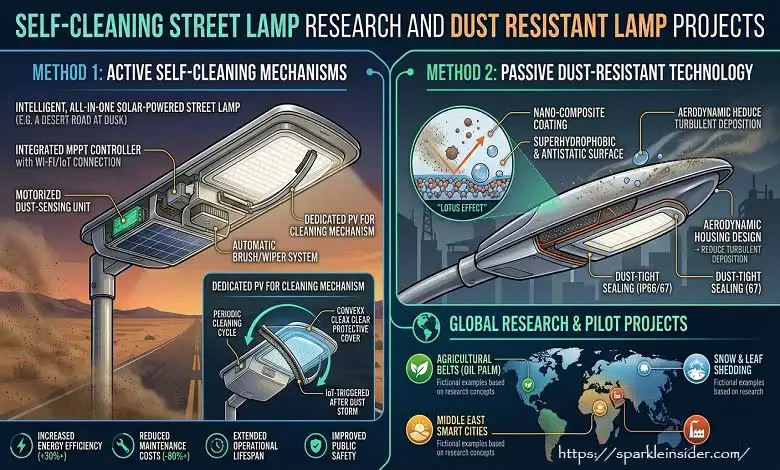
Street lighting plays a critical role in modern infrastructure. It improves road safety, supports nighttime transportation, and enhances urban security. However, one of the biggest challenges for outdoor lighting systems is dust accumulation. In many regions, especially polluted cities and desert environments, street lamps quickly collect dust, sand, and debris. This buildup can reduce brightness, damage components, and increase maintenance costs.
To address this issue, engineers and researchers have begun exploring self cleaning street lamp research dust resistant lamp project exist technologies. These innovations aim to create street lights that automatically clean themselves or resist dust buildup, ensuring consistent performance with minimal maintenance.
In recent years, several research projects and prototype systems have been developed that integrate automated cleaning mechanisms, smart sensors, and special surface coatings. These systems demonstrate that the concept of self cleaning street lamp research dust resistant lamp project exist is not only real but also becoming an important part of smart city infrastructure.
This article explores the technology behind self-cleaning street lamps, the research supporting their development, and how dust-resistant lamp projects could transform the future of urban lighting.
The Growing Problem of Dust in Street Lighting Systems
Street lights operate in outdoor environments where they are exposed to numerous environmental elements. Over time, dust particles, pollution, and moisture settle on lamp surfaces and solar panels. This contamination can significantly reduce lighting efficiency.
Even a thin layer of dust can reduce the amount of light reaching the ground. It can also reduce the efficiency of solar panels used in solar street lights. Studies show that when solar panels become dusty, their energy output can drop by at least 5% or more, and the loss becomes worse as more dust accumulates.
Dust accumulation causes several problems:
- Reduced brightness and illumination on roads
- Decreased solar panel efficiency
- Increased maintenance requirements
- Higher operational costs for municipalities
- Faster degradation of lighting equipment
Because street lamps are mounted on tall poles, cleaning them manually requires specialized equipment and trained workers. This process is expensive, time-consuming, and sometimes risky.
As a result, researchers started investigating new technologies through self cleaning street lamp research dust resistant lamp project exist initiatives.
Understanding Self Cleaning Street Lamp Technology
A self cleaning street lamp is a lighting system designed to automatically remove dirt, dust, and debris from its surfaces. These lamps use innovative technologies to maintain clean lenses and solar panels without manual cleaning.
The concept behind self cleaning street lamp research dust resistant lamp project exist combines several engineering approaches, including:
- Self-cleaning coatings
- Automated mechanical cleaning devices
- Dust-resistant housing design
- Smart sensors and monitoring systems
These technologies help ensure that street lights maintain optimal brightness and efficiency even in dusty environments.
Many self-cleaning street lights are also integrated with solar power systems, making them highly suitable for remote or off-grid locations.
Do Dust Resistant Lamp Projects Really Exist?
The short answer is yes. Multiple research studies and prototype designs confirm that self cleaning street lamp research dust resistant lamp project exist in real-world applications.
Researchers have developed automated cleaning systems that can remove dust from street lights using sensors, microcontrollers, and mechanical cleaning components. One study introduced a fully automatic cleaning system (FACS) that uses sensors to detect dust accumulation and activate cleaning mechanisms to maintain optimal lighting conditions.
Additionally, many modern solar street lights now include built-in cleaning features such as robotic brush arms that sweep across solar panels periodically to remove dirt and debris.
These examples show that self cleaning street lamp research dust resistant lamp project exist not only in theoretical research but also in practical engineering solutions.
Key Technologies Behind Self Cleaning Street Lamps
Self-cleaning street lights rely on several advanced technologies. These technologies work together to ensure the lamp remains clean and efficient.
1. Hydrophobic and Nanotechnology Coatings
One of the most promising solutions is the use of hydrophobic coatings. These coatings repel water and prevent dust particles from sticking to the lamp surface.
Inspired by the natural lotus effect, these surfaces cause water droplets to roll off the surface, carrying dirt and dust with them. Some research has even explored biodegradable coatings derived from natural materials such as palm oil to create environmentally friendly self-cleaning surfaces.
This approach allows street lights to clean themselves naturally whenever it rains.
2. Mechanical Self-Cleaning Systems
Another important innovation in this is the development of mechanical cleaning systems.
These systems typically use:
- Motorized brush arms
- Sliding wipers
- Rotating cleaning mechanisms
For example, some self-cleaning solar street lights include a robotic brush that moves across the solar panel surface periodically to remove dust. The cleaning process usually takes only a few minutes and consumes minimal energy.
These systems are especially useful in dry environments where rain is not available to wash away dust.
3. Dust-Resistant Structural Design
Engineering design also plays an important role in preventing dust accumulation.
Dust-resistant lamp projects focus on designing street lights with:
- Sealed lamp enclosures
- Smooth outer surfaces
- Angled panels that prevent dust buildup
- Protective covers over sensitive components
These structural improvements help minimize the amount of dirt that collects on the lamp.
4. IoT and Smart Monitoring Systems
Many modern street lighting projects combine self cleaning street lamp research dust resistant lamp project exist technology with smart city systems.
IoT-based sensors can monitor environmental conditions such as:
- Dust levels
- Light intensity
- Energy production
- Equipment performance
These sensors can automatically trigger cleaning cycles when dirt is detected, ensuring that the lamp continues to operate efficiently.
Smart monitoring also allows city administrators to track the performance of street lights remotely.
Self Cleaning Solar Street Lights
Solar street lights are one of the most important applications of self-cleaning technology.
These systems use photovoltaic panels to capture sunlight during the day and store energy in batteries for nighttime illumination. However, solar panels are extremely sensitive to dust.
If solar panels become dirty, their ability to generate electricity decreases significantly. This is why many solar lighting systems now include self-cleaning mechanisms.
Some advanced solar street lights even perform daily automated cleaning cycles to remove dust, bird droppings, and debris from the panel surface.
These innovations demonstrate how self cleaning street lamp research dust resistant lamp project exist technology can improve renewable energy systems.
Benefits of Self Cleaning Street Lamp Research
The development of self-cleaning street lamps offers numerous advantages for cities and infrastructure planners.
Reduced Maintenance Costs
Manual cleaning of street lights requires expensive equipment and labour. Self-cleaning technology reduces the need for frequent maintenance visits.
Improved Lighting Efficiency
Clean lamp lenses produce brighter and more consistent illumination, improving road safety for drivers and pedestrians.
Higher Solar Energy Production
Dust-free solar panels generate more electricity, ensuring that solar street lights remain operational throughout the night.
Longer Equipment Lifespan
Dust particles can damage sensitive components over time. Self-cleaning systems help protect these components and extend the lifespan of the lighting infrastructure.
Environmental Sustainability
Self-cleaning street lights support sustainable urban development by reducing maintenance emissions, energy consumption, and chemical cleaning processes.
Challenges in Dust Resistant Lamp Projects
Although self cleaning street lamp research dust resistant lamp project exist initiatives show great promise, there are still some challenges.
Higher Initial Costs
Self-cleaning systems often include additional hardware such as sensors, motors, and cleaning devices, which can increase installation costs.
Climate Limitations
Passive cleaning methods that rely on rain may not work effectively in extremely dry climates.
Also Read: Tech Giants Envision Future Beyond Smartphones: What Comes Next?
Maintenance of Mechanical Parts
Mechanical cleaning systems may eventually require repairs or replacement if moving parts wear out.
Despite these challenges, ongoing research continues to improve the efficiency and durability of these technologies.
Future of Self Cleaning Street Lamp Research
The future of urban lighting is closely connected to smart city technology.
Researchers are now working on next-generation solutions such as:
- AI-based maintenance prediction systems
- Advanced nano-coatings with self-healing properties
- Autonomous robotic cleaning devices
- Smart energy management systems
These innovations will further enhance the performance and reliability of street lighting systems.
As cities continue to modernize their infrastructure, the demand for self cleaning street lamp research dust resistant lamp project exist technologies will likely increase.
Conclusion
The concept of self cleaning street lamp research dust resistant lamp project exist is no longer just an idea. Real research studies, prototypes, and commercial products already demonstrate how these systems can automatically remove dust and maintain efficient lighting.
By combining advanced coatings, mechanical cleaning mechanisms, and smart monitoring technologies, engineers are developing street lights that require minimal maintenance while delivering consistent performance.
As urban populations grow and cities adopt smart infrastructure, self-cleaning street lamps will become an essential part of sustainable urban development. These innovations not only improve lighting efficiency but also reduce maintenance costs, increase energy efficiency, and support environmentally responsible city planning.
In the coming years, these technologies could transform the way cities manage outdoor lighting—making streets brighter, safer, and more sustainable for everyone.
FAQs:
A: A self-cleaning street lamp is a lighting system designed to automatically remove or resist dust accumulation using coatings, mechanical cleaning systems, or automated technologies.
A: Yes. Several research projects, prototypes, and pilot deployments have already explored this technology, particularly in environments where dust accumulation is a major problem.
A: They use different technologies such as hydrophobic coatings, mechanical wipers, electrostatic repulsion, or vibration systems to prevent or remove dust buildup.
A: Some experimental and limited commercial systems are already being tested in high-dust environments, including desert regions and industrial zones.
A: No. While solar street lights benefit greatly from dust-resistant technology, these systems can also be used in traditional grid-powered street lamps.
A: The main challenges include higher initial costs and adapting the technology to different environmental conditions.