
 By Mikel
Have you ever noticed how big breakthroughs usually come from conversations, not isolation? A casual exchange at an event, a shared frustration, a what if we tried this? moment — that’s where change begins. The Kellogg Innovation Network is built around exactly that idea.
It’s not just a formal institution or a corporate club. It feels more like a global meeting ground where leaders from different industries and countries step out of their silos and think together. And honestly, in today’s unpredictable world, that kind of shared thinking feels less like a luxury and more like a necessity.
What Is the Kellogg Innovation Network?
The Kellogg Innovation Network (KIN) is connected to the Kellogg School of Management at Northwestern University. But instead of focusing only on classrooms or textbooks, it connects global leaders through ongoing dialogue, forums, and summits.
Picture a space where a healthcare executive, a tech founder, a policymaker, and a sustainability advocate are all tackling the same issue from different angles. That diversity is not accidental — it’s the core strength of KIN.
It’s less about titles and more about perspectives.
Why Global Collaboration Is at the Core
Today’s challenges don’t respect borders. Climate change, digital disruption, supply chain issues — these are global problems. The Kellogg Innovation Network works on the belief that solutions must also be global.
Leaders in the network don’t just listen to speakers and leave. They build relationships that continue beyond events. That ongoing exchange helps turn ideas into action.
Here’s a simple look at how global collaboration through KIN makes a difference:
| Aspect | Traditional Approach | Kellogg Innovation Network Approach |
| Problem Solving | One company or sector works alone | Cross-industry and cross-country collaboration |
| Perspective | Local or industry-focused | Global, multi-sector viewpoints |
| Networking | Short-term connections | Long-term relationships |
| Outcome | Limited, narrow solutions | Broader, more adaptable strategies |
When leaders think beyond their own markets, their strategies naturally become more resilient.
Strategy in a Fast-Changing World
Business strategy used to be slow and steady. Now it feels more like steering a boat in changing weather. One new technology or regulation can shift everything.
The Kellogg Innovation Network encourages leaders to see strategy as flexible and evolving. Instead of asking only, How do we grow? The question becomes, How do we grow while staying responsible, resilient, and relevant?
That shift in thinking is huge.
| Old Strategy Mindset | Emerging Mindset Encouraged by KIN |
| Focus on short-term profits | Balance short-term results with long-term impact |
| Stable long-term plans | Adaptive, scenario-based planning |
| Industry-only insights | Cross-sector learning |
| Growth at any cost | Sustainable and responsible growth |
This broader approach helps organizations prepare for uncertainty instead of being surprised by it.
Conversations That Go Beyond Business
One thing that stands out about the Kellogg Innovation Network is the type of conversations it hosts. They aren’t just about revenue or market share.
Leaders discuss big topics like the future of work, ethical use of technology, and social responsibility. Sometimes these talks raise more questions than answers — and that’s actually the point.
When a business leader hears how a policy expert views AI regulation or how a sustainability leader sees environmental risk, their own strategy naturally expands. It becomes more connected to the real world.
Key Benefits of the Kellogg Innovation Network
- Encourages cross-sector collaboration by connecting leaders from business, academia, and government to solve complex global challenges.
- Provides access to a diverse global network, offering fresh perspectives and industry insights.
- Speeds up innovation by enabling idea sharing, partnerships, and faster execution of solutions.
- Bridges the gap between research and real-world application, turning ideas into practical results.
- Creates strong networking opportunities that can lead to strategic partnerships and business growth.
- Supports leadership development by enhancing strategic thinking and innovation skills.
- Promotes sustainable and meaningful innovation focused on long-term social and economic impact.
- Builds a global community that fosters continuous learning, collaboration, and future-ready solutions.
From Ideas to Real Impact
It’s fair to wonder whether all this discussion leads to anything practical. The interesting part is how often it does.
Connections made through the Kellogg Innovation Network can lead to partnerships, pilot projects, and new strategic directions. A company might rethink its digital transformation after hearing lessons from others. A leader might redesign their sustainability plan after global discussions on risk.
The impact may not always be flashy, but it shapes decisions inside organizations — and that’s where real change happens.
The Human Side of Leadership
Behind every strategy are people making tough decisions. And people learn best from stories, not just slides.
KIN spaces often encourage leaders to share personal experiences — mistakes, surprises, lessons learned the hard way. That honesty creates trust and deeper learning.
Hearing someone admit, “We expanded too fast and had to rethink everything,” can be more powerful than any formal case study. It reminds everyone that leadership is a journey.
Why the Kellogg Innovation Network Matters Now
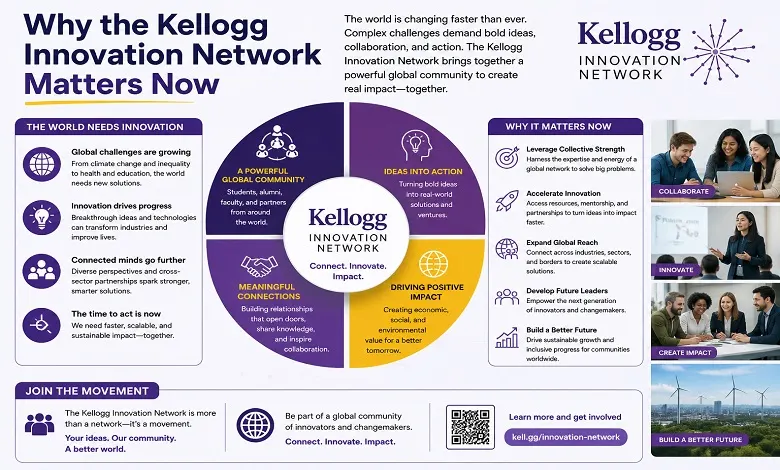
The world feels more connected and more complicated at the same time. No leader can understand every market, technology, or social issue alone.
That’s why the Kellogg Innovation Network plays such an important role. It creates a space where global collaboration supports smarter, more balanced strategic growth.
In a way, the real innovation is not just in new ideas — it’s in how leaders learn together.
Conclusion
The Kellogg Innovation Network shows that collaboration is more than a buzzword. It’s a practical way to navigate uncertainty, drive strategic growth, and build organizations that are ready for the future.
When diverse voices come together with curiosity and openness, strategies become stronger. And in today’s world, that collective intelligence might be the biggest advantage of all.
FAQs:
A: The Kellogg Innovation Network is a global community linked to the Kellogg School of Management that connects leaders across industries to discuss innovation, strategy, and global challenges.
A: It helps leaders gain diverse perspectives, form partnerships, and develop more adaptable, long-term strategies.
A: Business leaders, academics, policymakers, entrepreneurs, and experts from different sectors and countries.
A: Because many modern challenges are global, and cross-border cooperation leads to more effective and sustainable solutions.
A: No, discussions often include technology, sustainability, leadership, ethics, and social impact alongside business strategy.